The French advertising poster, a century of illustration
The history of the French advertising poster in 4 eras: the Belle Époque of Chéret and Mucha, the interwar years of Cassandre and Broders, the postwar era of Savignac and Villemot, and today’s revival. The great poster artists, the icons, and the reasons for its lasting appeal.

Key points
- 62 posters in the Art Deco posters collection, the 20 from this article in the table below.
- From 19,95 € in A4, up to 69,95 € in A0, 5 sizes for each poster.
- Printed in Europe on demand, free delivery from 59 €.
The table
The 20 posters at a glance




Before television, even before radio, there was the poster. Pasted on the hoardings of Paris, hung in train stations, handed out in cafés, it announced shows, praised aperitifs and celebrated night train journeys.
For nearly a century, the poster served as both a popular art form and the main medium of its day. From Chéret to Savignac, by way of Mucha, Cassandre and Toulouse-Lautrec, it employed the greatest French artists and left behind an invaluable graphic heritage. Here is its story.
The history of the French advertising poster, from Toulouse-Lautrec to PLM
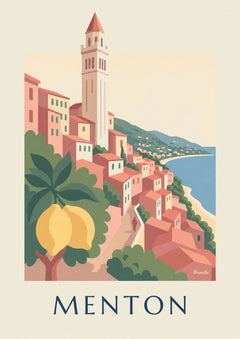
The French advertising poster was born in the late 19th century. Toulouse-Lautrec, Mucha and Chéret set the codes: the female silhouette, ornate lettering, a carefully framed palette. In the 20th century, the PLM and SNCF railway companies turned the poster into a tool for promoting tourism across the country. 50 years of graphic innovation that now form the foundation of Brunelia’s posters.
The origins: commercial lithography (1860-1890)
The modern advertising poster was born in Paris around 1860 with the arrival of commercially viable color lithography. Jules Chéret is the absolute pioneer: he printed thousands of posters for theaters, cabarets and luxury goods. His “Chérette” (a light, airy female figure) became the icon of the Belle Époque.
The Belle Époque golden age (1890-1914)
Toulouse-Lautrec, Mucha, Steinlen, Cappiello: the Belle Époque turned the poster into a major art form. La Goulue (Toulouse-Lautrec, 1891), Job (Mucha, 1896) and Le Chat Noir (Steinlen, 1896) became global icons. The poster artist’s signature became as important as a painter’s.
Roger Broders and the PLM era (1922-1932)
After World War I, seaside and Alpine tourism became accessible to more people. The Compagnie des Chemins de fer Paris-Lyon-Méditerranée hired Roger Broders, who between 1922 and 1932 created around 100 of the most recognizable PLM posters. Cassis, Bandol, La Ciotat, Sainte-Maxime: he invented the grammar of the modern travel poster.
Cassandre and geometric Art Deco (1925-1940)
A.M. Cassandre revolutionized the poster in the 1920s and 30s. Étoile du Nord (1927), Normandie (1935), Wagons-Lits (1934): he introduced Cubist geometry, bold flat areas of color and typographic minimalism. His influence defined 20th-century commercial graphic design.
Loupot, Carlu, Colin: a diversity of schools (1930-1950)
Charles Loupot created the Saint-Raphaël and Nicolas posters. Jean Carlu invented the modern political poster. Paul Colin brought Josephine Baker and Parisian jazz to the stage. Each poster artist developed a style of their own, but all shared the terracotta, gold and deep blue palette that defines the French interwar poster.
The postwar era and the graphic turning point (1945-1970)
Bernard Villemot, Raymond Savignac, Hervé Morvan: after the war, the poster reinvented itself with simpler, more humorous graphics. Bonjour Paris (Villemot, 1956), Bally (Villemot, 1979), Aspirine (Savignac, 1956). A gradual shift from painted illustration to vector illustration.
The photographic turn and the end of commercial illustration (1970-2000)
From 1970 onward, photography gradually replaced painted illustration in advertising. The illustrated poster became marginal, reserved for galleries and collectors. That gap created today’s market for poster reproductions: Brunelia follows directly in the footsteps of the great pre-1970 poster artists.
The contemporary revival (2000-today)
Since 2000, the illustrated poster has made a strong comeback, driven by home decor and a passion for all things retro. Contemporary studios, independent illustrators and brands like Brunelia are reviving the visual grammar of the 1920s-1950s with modern printing techniques.
The French advertising poster is one of the few graphic arts to have lasted a century without losing its readability. A 1927 Cassandre poster still works visually today because it rests on timeless principles: flat areas of color, supple geometry, hand-drawn lettering.
To learn more about Roger Broders, see our full article on the PLM illustrator. See also our guide to the 20 posters that made history.

The poster for this part
Woman in polka dot dress choosing a song at the jukebox poster
from 19,95 €
Build this wall
3 posters from this article, at true scale


All 3 posters: 99,85 €
Frequently asked questions
You often ask us
Who invented the modern advertising poster?
Jules Chéret (1836-1932), with his colorful advertising “Chérettes.” Toulouse-Lautrec (1864-1901) built on those codes for the Moulin Rouge.
When was the golden age of the French poster?
1920-1950. The PLM and SNCF railway companies commissioned Cassandre, Roger Broders and Jean Dupas to promote French tourist destinations.
Which style dominated advertising posters in the 1930s?
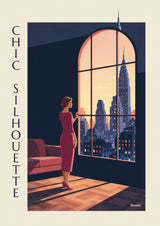
Art Deco. Geometry, gilding, stylized silhouettes and sans-serif lettering. It inspires most of our current collection.
How much does an authentic period poster cost?
The price of a vintage poster depends on its artist, edition, condition and provenance, among other things. Consult a specialist gallery or auction results for a specific work. For decor, distinguish between an authenticated vintage poster, an identified reproduction and a contemporary illustration in a retro style.
Why did posters come back into fashion?
A vintage revival in the 2010s, sought after by collectors and by fans of grown-up decor. Its distinctive graphic language and French cultural patina make it an heirloom to pass down in the family.
Keep exploring